src="files/bkh_pictures.jpg">
Breed Guide: British Shorthair
One of the cat breeds that truly everyone knows is the British Shorthair. If some of you are now frowning and saying – no, not me… then let's call her briefly by her “old” (and not quite correct) name: Chartreux cat. That should bring a clear “ahhhh” moment, especially for those who were kids in the 70s 😊
The British Shorthair in blue was, after all, commonly called that for years in everyday speech. However, that's misleading – the Chartreux is its own breed, which looks similar but not identical.
BSH, as these pretty bundles of fur are abbreviated, aren't just well-known – they're also rightfully extremely popular. Because their character matches their looks perfectly. These cozy, fluffy-looking cats are sweet, cuddly kitties who are extremely affectionate towards people while also being playful. What's more, they're well suited for families, as they respond well to children and are balanced and calm by nature. The perfect cat, in other words… But let's start from the beginning!
British Shorthair – the origin of the breed
The British Shorthair comes, as the name already suggests, from Great Britain. Its origins there actually go back over 2000 years, since the Romans brought cats to Great Britain at that time. However, it was a long way from a Roman import to becoming its own breed – the British Shorthair wasn't recognized as a breed until 1960.
During the two World Wars, the number of British Shorthairs declined so much that the breed was threatened with extinction. That's why other breeds, such as the Persian cat, were crossed in to secure the British Shorthair population. This is still visible in the cats today, particularly in their stocky build.
One of the cat breeds that truly everyone knows is the British Shorthair. If some of you are now frowning and saying – no, not me… then let's call her briefly by her “old” (and not quite correct) name: Chartreux cat. That should bring a clear “ahhhh” moment, especially for those who were kids in the 70s 😊
The British Shorthair in blue was, after all, commonly called that for years in everyday speech. However, that's misleading – the Chartreux is its own breed, which looks similar but not identical.
BSH, as these pretty bundles of fur are abbreviated, aren't just well-known – they're also rightfully extremely popular. Because their character matches their looks perfectly. These cozy, fluffy-looking cats are sweet, cuddly kitties who are extremely affectionate towards people while also being playful. What's more, they're well suited for families, as they respond well to children and are balanced and calm by nature. The perfect cat, in other words… But let's start from the beginning!
British Shorthair – the origin of the breed
The British Shorthair comes, as the name already suggests, from Great Britain. Its origins there actually go back over 2000 years, since the Romans brought cats to Great Britain at that time. However, it was a long way from a Roman import to becoming its own breed – the British Shorthair wasn't recognized as a breed until 1960.
During the two World Wars, the number of British Shorthairs declined so much that the breed was threatened with extinction. That's why other breeds, such as the Persian cat, were crossed in to secure the British Shorthair population. This is still visible in the cats today, particularly in their stocky build.
Appearance and character of the BSH
The short, dense and easy-to-care-for coat of the British Shorthair, its short, round head and large, round eyes are strongly reminiscent of a living teddy bear. She is, so to speak, the cat version of the baby-face effect. This is also what makes her one of the most popular cat breeds these days. Put simply, pretty much everything about these kitties is round – and we love it!
British Shorthairs tend to be on the larger side: fully grown males can weigh up to seven kilos, and females still around five. As is typical for larger breeds, they grow rather slowly and are only considered fully grown at three to four years old. Which of course also means that their playful phase tends to last longer. The best-known colour among British Shorthairs is the famous blue. But by now, of course, there are all sorts of other colours and tabby patterns too. With a solid colour, by the way, the cats are meant to be coloured all the way through – meaning a blue BSH really is blue from the tip of her nose to the tip of her tail.
Her character is – generally speaking – wonderful. As we all know, cats are extreme individualists, yet based on decades of breeding experience we can still assign certain character traits fairly reliably. So what does that mean for our beloved BSHs?
The British Shorthair is generally considered easy-going, sometimes a bit reserved, affectionate, cuddly and very lovable. She fits into families with children, but also with seniors. These cats don't have an overly strong urge to move around, which makes them well suited to apartment living – as long as you still meet their naturally pronounced need for movement and play.
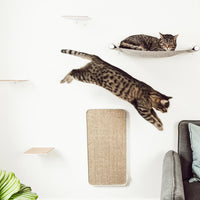
What's special is that these furballs love to play. Female British Shorthairs in particular are considered very easy to get excited about play. HERE you'll find possible toys for your cat. This is also a great prerequisite for an indoor cat – because when we as owners can simply meet our cats' needs, happy cats are the result. Very important: if your British girl is going to live exclusively indoors with you, please be sure to keep her with a companion – because the BSH is very social and doesn't like being completely alone. And of course, be sure to meet her needs for resting, playing, exploring, scratching and observing. Some suggestions on what that can look like can be found HERE.
Towards strangers, the British Shorthair is usually not particularly open, but towards other animals she often is. Good socialisation is important, and in case of introductions, a well-managed introduction process.
In addition, these cats (very true to their reputation as Brits) tend to be quiet cats that don't meow much. If she suddenly becomes very chatty, that often means something isn't quite right.
Appearance and character of the BSH
The short, dense and easy-to-care-for coat of the British Shorthair, its short, round head and large, round eyes are strongly reminiscent of a living teddy bear. She is, so to speak, the cat version of the baby-face effect. This is also what makes her one of the most popular cat breeds these days. Put simply, pretty much everything about these kitties is round – and we love it!
British Shorthairs tend to be on the larger side: fully grown males can weigh up to seven kilos, and females still around five. As is typical for larger breeds, they grow rather slowly and are only considered fully grown at three to four years old. Which of course also means that their playful phase tends to last longer. The best-known colour among British Shorthairs is the famous blue. But by now, of course, there are all sorts of other colours and tabby patterns too. With a solid colour, by the way, the cats are meant to be coloured all the way through – meaning a blue BSH really is blue from the tip of her nose to the tip of her tail.
Her character is – generally speaking – wonderful. As we all know, cats are extreme individualists, yet based on decades of breeding experience we can still assign certain character traits fairly reliably. So what does that mean for our beloved BSHs?
The British Shorthair is generally considered easy-going, sometimes a bit reserved, affectionate, cuddly and very lovable. She fits into families with children, but also with seniors. These cats don't have an overly strong urge to move around, which makes them well suited to apartment living – as long as you still meet their naturally pronounced need for movement and play.
What's special is that these furballs love to play. Female British Shorthairs in particular are considered very easy to get excited about play. HERE you'll find possible toys for your cat. This is also a great prerequisite for an indoor cat – because when we as owners can simply meet our cats' needs, happy cats are the result. Very important: if your British girl is going to live exclusively indoors with you, please be sure to keep her with a companion – because the BSH is very social and doesn't like being completely alone. And of course, be sure to meet her needs for resting, playing, exploring, scratching and observing. Some suggestions on what that can look like can be found HERE.
Towards strangers, the British Shorthair is usually not particularly open, but towards other animals she often is. Good socialisation is important, and in case of introductions, a well-managed introduction process.
In addition, these cats (very true to their reputation as Brits) tend to be quiet cats that don't meow much. If she suddenly becomes very chatty, that often means something isn't quite right.
Health and care of the British Shorthair
As a pedigree breed, the British Shorthair is fairly robust, and thankfully you won't find any extreme-breeding traits here. However, all pedigree cats have one or two genetically based ailments that crop up more often. Unfortunately, the beautiful British girl isn't exempt from this either. In general, no cat is completely safe from illness, but in pedigree cats these occur more frequently due to the artificially narrowed gene pool. For the British Shorthair, this means: her sturdy build can sometimes put strain on her bones and joints. It's important to maintain a healthy weight throughout her life and to avoid overfeeding accordingly. Unfortunately, heart conditions such as hypertrophic cardiomyopathy (HCM) as well as haemophilia B, a blood disorder, also occur more frequently in British Shorthair cats. There's not much you can do here other than visit the vet regularly and, should a diagnosis in this direction occur, start the appropriate steps, i.e. medication.
The abbreviation PKD also causes a stir among connoisseurs. Hereditary kidney cysts, or Polycystic Kidney Disease, occur more often in British Shorthair cats. Persian cats suffer from it too – and as we remember, the two breeds are closely related. Symptoms only appear late in life, which means affected cats could pass on the disease unnoticed for a long time. Since it's a hereditary condition, potential breeding cats should be tested for it beforehand.
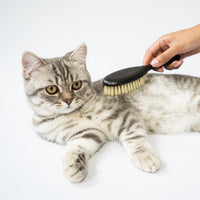
Her coat is very easy to care for, and like many cats, most British Shorthairs really enjoy this special cuddly grooming time – you can find more details in our article on cat wellness (HERE).
All in all, here at LucyBalu we can only say – we deeply understand why the British Shorthair is one of the most popular cat breeds – and why you can never get enough of them.
Health and care of the British Shorthair
As a pedigree breed, the British Shorthair is fairly robust, and thankfully you won't find any extreme-breeding traits here. However, all pedigree cats have one or two genetically based ailments that crop up more often. Unfortunately, the beautiful British girl isn't exempt from this either. In general, no cat is completely safe from illness, but in pedigree cats these occur more frequently due to the artificially narrowed gene pool. For the British Shorthair, this means: her sturdy build can sometimes put strain on her bones and joints. It's important to maintain a healthy weight throughout her life and to avoid overfeeding accordingly. Unfortunately, heart conditions such as hypertrophic cardiomyopathy (HCM) as well as haemophilia B, a blood disorder, also occur more frequently in British Shorthair cats. There's not much you can do here other than visit the vet regularly and, should a diagnosis in this direction occur, start the appropriate steps, i.e. medication.
The abbreviation PKD also causes a stir among connoisseurs. Hereditary kidney cysts, or Polycystic Kidney Disease, occur more often in British Shorthair cats. Persian cats suffer from it too – and as we remember, the two breeds are closely related. Symptoms only appear late in life, which means affected cats could pass on the disease unnoticed for a long time. Since it's a hereditary condition, potential breeding cats should be tested for it beforehand.
Her coat is very easy to care for, and like many cats, most British Shorthairs really enjoy this special cuddly grooming time – you can find more details in our article on cat wellness (HERE).
All in all, here at LucyBalu we can only say – we deeply understand why the British Shorthair is one of the most popular cat breeds – and why you can never get enough of them.