src="files/napf-hoch_pictures.jpg">
Bowls up! Why cats prefer to stand elevated when eating
Easy on the back, more relaxed, healthier: Why a raised food bowl makes long-term sense for cats – and what you should pay attention to.
Cats Don't Like Eating “Off the Floor”
Watch a cat eating closely: if she has to lower her head sharply, tense her shoulders, and hunch her back, it rarely looks relaxed. This is exactly where the concept of elevated eating comes in – and yes, the idea isn't just a design trend, it makes anatomical sense.
Cats are natural-born hunters who fix their prey from a slightly elevated position. In the wild, they rarely eat directly “off the ground”, but rather in a posture where the head, neck, and spine as straight as possible remain. If the bowl is permanently placed on the floor, an unnatural posture results – especially in larger cats, seniors, or animals with back or joint problems.
Veterinary and physiotherapy assessments show: an elevated eating position can reduce strain on the cervical spine, shoulders, and elbows. Cats with arthritis, spondylosis, or age-related stiffness benefit noticeably in particular. But young, healthy cats, too, often eat more calmly and with more focus when they don't have to “bend downward”.
Another point: stress. An unfavourable posture can unconsciously lead to tension – and stress, in turn, has a negative effect on digestion and eating behaviour. Elevated eating leads to a more relaxed posture – and relaxed cats simply eat better.
A bowl on the floor is functional for cats, but not optimal. A few centimetres of height can make a big difference in the long run.
Cats Don't Like Eating “Off the Floor”
Watch a cat eating closely: if she has to lower her head sharply, tense her shoulders, and hunch her back, it rarely looks relaxed. This is exactly where the concept of elevated eating comes in – and yes, the idea isn't just a design trend, it makes anatomical sense.
Cats are natural-born hunters who fix their prey from a slightly elevated position. In the wild, they rarely eat directly “off the ground”, but rather in a posture where the head, neck, and spine as straight as possible remain. If the bowl is permanently placed on the floor, an unnatural posture results – especially in larger cats, seniors, or animals with back or joint problems.
Veterinary and physiotherapy assessments show: an elevated eating position can reduce strain on the cervical spine, shoulders, and elbows. Cats with arthritis, spondylosis, or age-related stiffness benefit noticeably in particular. But young, healthy cats, too, often eat more calmly and with more focus when they don't have to “bend downward”.
Another point: stress. An unfavourable posture can unconsciously lead to tension – and stress, in turn, has a negative effect on digestion and eating behaviour. Elevated eating leads to a more relaxed posture – and relaxed cats simply eat better.
A bowl on the floor is functional for cats, but not optimal. A few centimetres of height can make a big difference in the long run.
Better Posture, Better Digestion, Less Spilling
Besides posture, bowl height also affects digestion. With elevated eating, the path of food from the mouth to the oesophagus can run in a straighter line. This makes swallowing easier and, in some cats, can reduce gulping, choking, or occasional regurgitation. This is often observed as a positive effect, particularly in cats that eat hastily or tend to have a sensitive stomach.
A raised bowl also has practical advantages:
- less food ends up next to the bowl
- less “pushing” the bowl around the home
- a cleaner environment
- a clearly defined feeding spot
Cats like order – including at mealtimes. A stable, raised bowl signals: This is my spot, here I can eat in peace. That increases acceptance, especially in multi-cat households, where competitive stress can play a role.
The right height matters here. As a rough guideline:
- the bowl should stand at roughly the cat's chest height
- the head should only be slightly tilted, not sharply lowered
- the cat should be able to eat relaxed while standing or sitting
Too high is just as unfavourable as too low. Bowl solutions specifically developed for cats are ideal – not improvised bar-stool constructions from the kitchen.
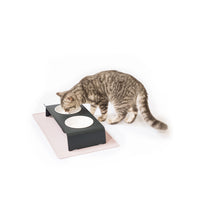
Elevated eating isn't a fad, but a small adjustment with a big impact – for posture, digestion, and cleanliness. We therefore recommend raised food bowls such as DROP or MYCO, as well as our feeding stations DELI, DINE and BUFFET.
Better Posture, Better Digestion, Less Spilling
Besides posture, bowl height also affects digestion. With elevated eating, the path of food from the mouth to the oesophagus can run in a straighter line. This makes swallowing easier and, in some cats, can reduce gulping, choking, or occasional regurgitation. This is often observed as a positive effect, particularly in cats that eat hastily or tend to have a sensitive stomach.
A raised bowl also has practical advantages:
- less food ends up next to the bowl
- less “pushing” the bowl around the home
- a cleaner environment
- a clearly defined feeding spot
Cats like order – including at mealtimes. A stable, raised bowl signals: This is my spot, here I can eat in peace. That increases acceptance, especially in multi-cat households, where competitive stress can play a role.
The right height matters here. As a rough guideline:
- the bowl should stand at roughly the cat's chest height
- the head should only be slightly tilted, not sharply lowered
- the cat should be able to eat relaxed while standing or sitting
Too high is just as unfavourable as too low. Bowl solutions specifically developed for cats are ideal – not improvised bar-stool constructions from the kitchen.
Elevated eating isn't a fad, but a small adjustment with a big impact – for posture, digestion, and cleanliness. We therefore recommend raised food bowls such as DROP or MYCO, as well as our feeding stations DELI, DINE and BUFFET.
Who Benefits Most from Elevated Eating
Basically, almost all cats benefit from a slightly elevated eating position. However, it makes particular sense for certain groups:
- Senior cats, whose mobility is declining
- large or heavy cats, who need to support themselves more
- cats with joint, back, or neck problems
- cats with digestive sensitivity
- cats that eat hastily or restlessly
Indoor cats with little exercise benefit in the long run from every ergonomic improvement in daily life. After all, eating is an activity that happens several times a day – small strains add up.
Important: elevated eating doesn't replace good nutrition or veterinary care. But it's a simple, everyday measure to boost well-being. Comparable to a good chair for us humans – no one has to sit ergonomically, but in the long run it simply feels good.
And one more bonus: many cats perceive a raised bowl more quickly as a “valuable spot”. Less distraction, less stress, more focus on eating. That's exactly what we want.
Bottom line: A raised food bowl isn't a luxury, but a small upgrade for feline health. It's easier on the body, supports digestion, and turns a daily necessity into a relaxed ritual. Or put another way: a little height – and life tastes better right away.
Who Benefits Most from Elevated Eating
Basically, almost all cats benefit from a slightly elevated eating position. However, it makes particular sense for certain groups:
- Senior cats, whose mobility is declining
- large or heavy cats, who need to support themselves more
- cats with joint, back, or neck problems
- cats with digestive sensitivity
- cats that eat hastily or restlessly
Indoor cats with little exercise benefit in the long run from every ergonomic improvement in daily life. After all, eating is an activity that happens several times a day – small strains add up.
Important: elevated eating doesn't replace good nutrition or veterinary care. But it's a simple, everyday measure to boost well-being. Comparable to a good chair for us humans – no one has to sit ergonomically, but in the long run it simply feels good.
And one more bonus: many cats perceive a raised bowl more quickly as a “valuable spot”. Less distraction, less stress, more focus on eating. That's exactly what we want.
Bottom line: A raised food bowl isn't a luxury, but a small upgrade for feline health. It's easier on the body, supports digestion, and turns a daily necessity into a relaxed ritual. Or put another way: a little height – and life tastes better right away.